Intention LEAN Operation & Project
for all kind of industries
1
cLEAN: LEAN Operations to train problem solving competences
5S (Basic workplace organisation)
Focus on value stream analysis
Continuous improvement (Kaizen)
Standardization & visual management for efficiency
Empowerment of frontline employees
Just-in-time (JIT) & PULL production (Produce what customer needs, i.e. NOT for productivity)
ciDA: LEAN/AGILE Project Management to benefit from problem solving competences
Workflows derived from LEAN principles: iterative planning, continuous learning, transparency,
empowerment, cross functional flows
Overall solution & mission orientation: Milestone management, risk assessment, priorization
Organisation: servant leadership to foster self organization of teams & empowerment
Delivery: Early and continuous (incremental)
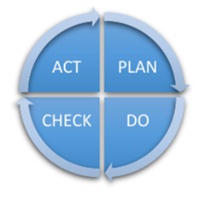
PLAN
DOCHECK
ACT
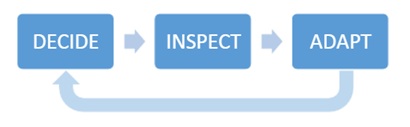
DECIDE INSPECT ADAPT
2
Aspect
Bad LEAN =
burning organizations
&
(human) ressources
Good
LEAN = cLEAN
Focus
Cost
cutting with all means
Continuous
improvement & value creation
Leadership
Command
and control
Empowering
employees & servant leadership
Employee
engagement
Fear
driven, minimal involvement
Active participation, ownership of improvements
Problem
solving
Quick fixes,
bandaid solutions
Root cause analysis & sustainable solutions
Customer
satisfaction
Ignored, focus on short term gains
Central to strategy, long
term customer value
Waste
Management
Surface
level reduction
Systematic elimination of waste & inefficiencies
Standardization
Rigid &
bureaucratic
Flexible, adaptable & continuously evolving
Kaizen (
Continuous Improvement
)
Rare,
reactive changes
Regular, proactive improvements led by all
Culture
Toxic
, blame driven
Supportive
, collaborative, learning focused
Measurement &
metrics
Focused only on cost savings
Balanced performance metrics, including quality & efficiency
Main improvement
LEAN methods
Operations with low maturity level often made initital bad experiences with 1st LEAN introductions.
(considering it a „fashionor hypewithout purpose and benefit)
Main improvement
LEAN results --- as a journey
What to expect from cLEAN:
Process optimization
Organisation development
A maturity model for process orientation
Find bottlenecks and unleash hidden strengths
Immaterial values take lead over material indicators
Learning arises from change
Remark: cLEAN needs
committment by top management
roll out also in office areas
agreement with employee representatives (in countries with legally regulated co-determination)
Main improvement
LEAN results --- examples Steel industry
Area Before LEAN After LEAN
Blast Furnace Operation
Manual data entry causing delays and inaccuracy in furnace performance
tracking
Automated data logging with dashboards for furnace efficiency monitoring
Steel Casting Process
Inconsistent mold changes causing production delays and defects
Standardized mold changeover procedures reduce variation and defects
Crane Handling
Frequent crane bottlenecks
Visual scheduling and load balancing improves crane logistics
Heavy Equipment
Maintenance
Reactive repairs of ladles, cranes and rollers leading to unplanned
downtime
Predictive maintenance on key equipment reduces downtime (TPM)
Production Planning
Batch
-based planning with high WIP and waiting times
Flow
-oriented planning reduces WIP and increases throughput
Workforce Utilization
Skilled labor underutilized due to isolated operations
Cross
-training and multi-skilled teams enhance flexibility and productivity
Waste Management
Slag, dust and offcuts not reused or recycled effectively
Waste segregation and reuse systems implemented to reduce environmental
impact
Inventory & Spare Parts
Excess spare parts stocked with no visibility of usage trends
Kanban system for spares management improves availability and reduces
overstocking
Process Monitoring
Lack of real
-time monitoring leading to unnoticed process deviations
SCADA and IoT
-based real-time alerts for key parameters
Project Execution
Delayed project timelines due to unclear responsibilities and scope shifts
Project charters and visual management ensure timely, focused execution
Energy Consumption
Unmonitored power usage with frequent wastage
Energy monitoring systems and usage reduction initiatives
Workplace Safety
Cluttered work areas with unstandardized safety practices
5S implementation leading to cleaner, safer workspaces
Main improvement
LEAN methods
Here are some key strategies:
1. Eliminate Waste Apply Lean methodologies to reduce
material waste, energy consumption and emissions in
industrial processes.
2. Optimize Resource Use Streamline operations to use fewer
raw materials and maximize efficiency in production.
3. Enhance Circular Economy Implement recycling and reuse
strategies to extend the life cycle of materials and reduce
dependency on new resources.
4. Improve Energy Efficiency Use LEAN techniques to identify
and eliminate energy inefficiencies, promoting cleaner
production methods.
5. Sustainable Supply Chains Work with suppliers to ensure
sustainable sourcing and minimize environmental impact
across the supply chain.
6. Continuous Improvement Foster a culture of ongoing
innovation to integrate LEAN and green practices into
industrial policies.
The Clean Industrial Deal focuses on
decarbonization, circularity and competitiveness.
Preparing continuously the Deal with LEAN can help
industries become more efficient while developing
to a low carbon economy and reducing
environmental impact.
LEAN model:
Continuous target orientation
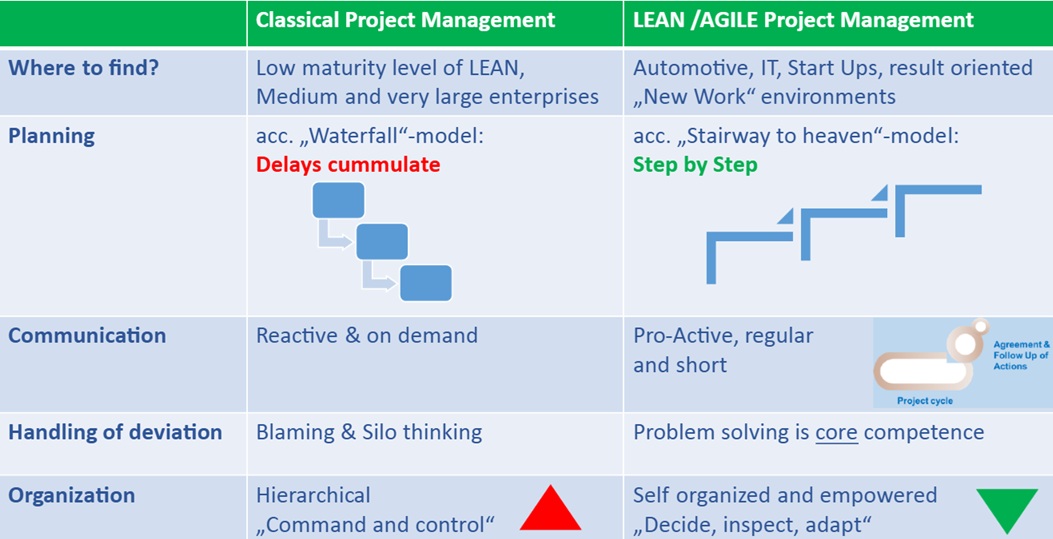
Classical
Project Management
Where
to find?
Low
maturity level of LEAN,
Medium
and very large enterprises
IT, Start Ups, result oriented
environments
Planning
acc
. „Waterfall-model:
Delays
cummulate
. „Stairway to heaven-model:
by Step
Communication
Reactive
&on demand
-Active, regular
short
Handling
of deviation
Blaming
& Silo thinking
solving is core competence
Organization
Hierarchical
„Command
and control
organized and empowered
Decide, inspect, adapt
Main innovation
Project Management frameworks
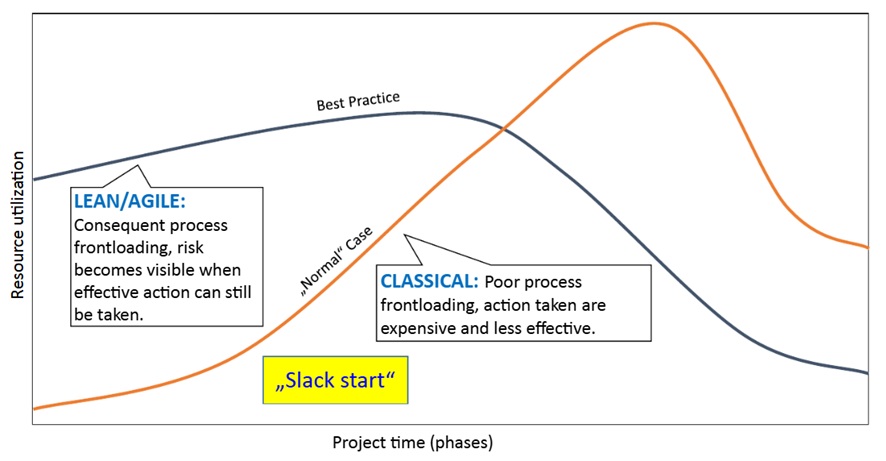
LEAN/AGILE:
Consequent process
frontloading, risk
becomes visible when
effective action can still
be taken.
CLASSICAL: Poor process
frontloading, action taken are
expensive and less effective.
Resource utilization
Project time (phases)
Slack start
Project Practices
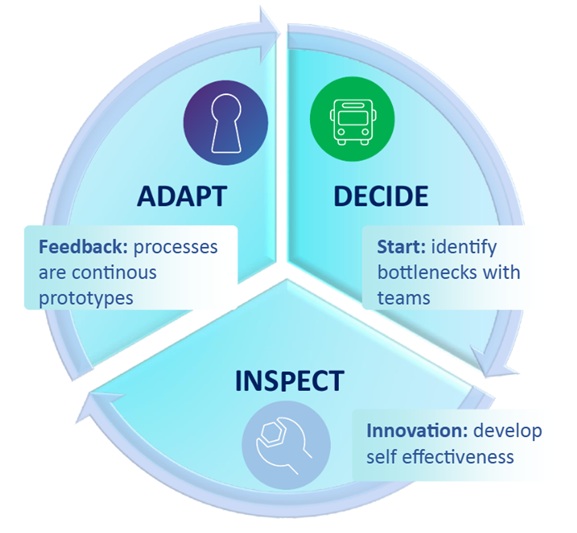
DECIDE
INSPECT
ADAPT
Start: identify
bottlenecks with
teams
Feedback: processes
are continous
prototypes
Innovation: develop
self effectiveness
We transform Bottom-Up:
Listen needs and interest
Systematic involvement of all
PARTNERS: Participation and
determination
Bottom-Up does only fail briefly
(„fail fast and soft“) and creates
learning and adaptation
Process in short cycle = „Shuttle“
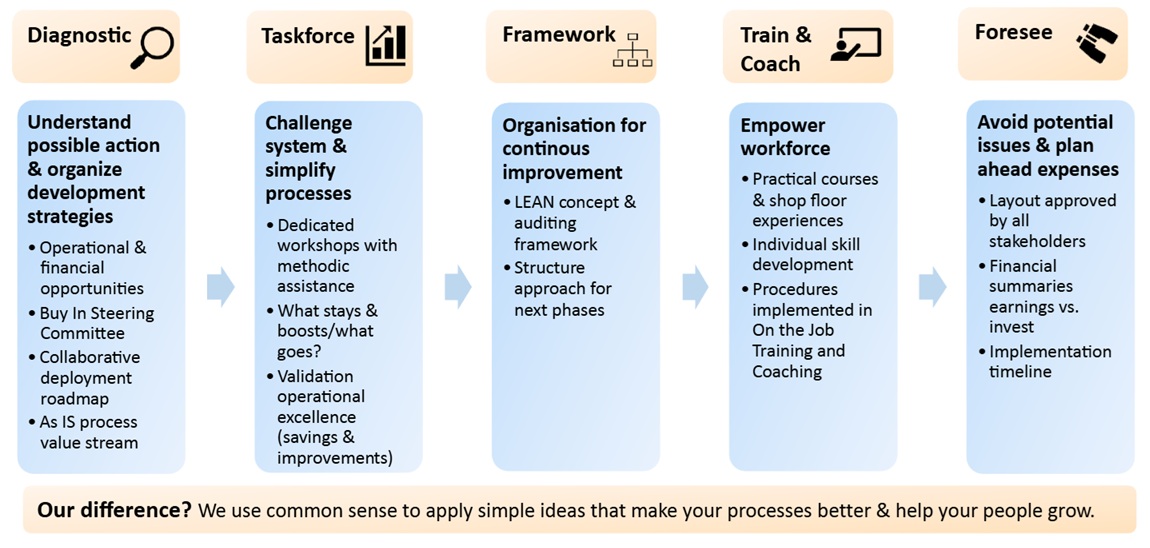
Understand
possible action
& organize
development
strategies
Operational &
financial
opportunities
Buy In Steering
Committee
Collaborative
deployment
roadmap
As IS process
value stream
Challenge
system &
simplify
processes
Dedicated
workshops with
methodic
assistance
What stays &
boosts/what
goes?
Validation
operational
excellence
(savings &
improvements)
Organisation for
continous
improvement
LEAN concept &
auditing
framework
Structure
approach for
next phases
Empower
workforce
Practical courses
& shop floor
experiences
Individual skill
development
Procedures
implemented in
On the Job
Training and
Coaching
Avoid potential
issues & plan
ahead expenses
Layout approved
by all
stakeholders
Financial
summaries
earnings vs.
invest
Implementation
timeline
Exemplary Approach
Train &
Coach
Framework Foresee
Our difference? We use common sense to apply simple ideas that make your processes better & help your people grow.
Diagnostic Taskforce
Methodology
We consult, coach and train any needed tools depending on customer demand.
We interact in all industrial and support processes.
LEAN PLUS: With an IoT - IT support when necessary.
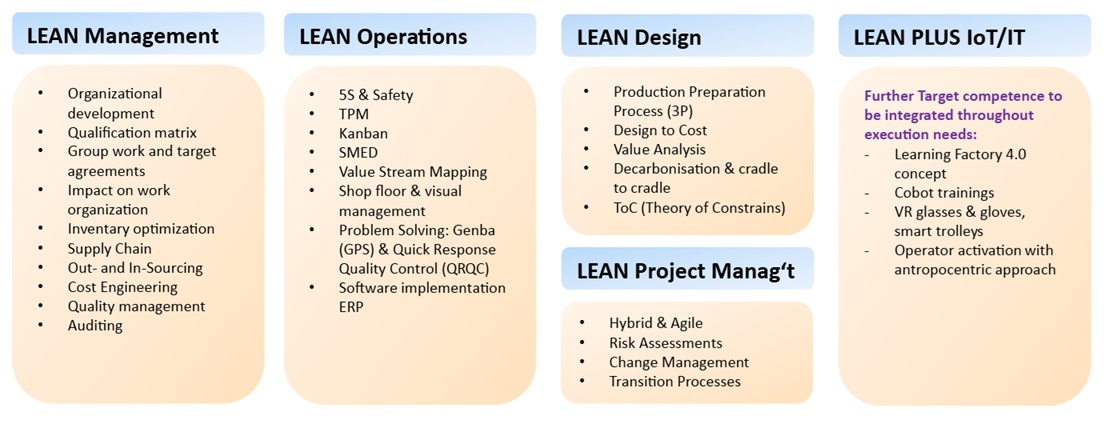
Organizational
development
Qualification matrix
Group work and target
agreements
Impact on work
organization
Inventary optimization
Supply Chain
Out- and In-Sourcing
Cost Engineering
Quality management
Auditing
LEAN Management
5S & Safety
TPM
Kanban
SMED
Value Stream Mapping
Shop floor & visual
management
Problem Solving: Genba
(GPS) & Quick Response
Quality Control (QRQC)
Software implementation
ERP
LEAN Operations
Production Preparation
Process (3P)
Design to Cost
Value Analysis
Decarbonisation & cradle
to cradle
ToC (Theory of Constrains)
LEAN Design
Further Target competence to
be integrated throughout
execution needs:
- Learning Factory 4.0
concept
- Cobot trainings
- VR glasses & gloves,
smart trolleys
- Operator activation with
antropocentric approach
LEAN PLUS IoT/IT
Hybrid & Agile
Risk Assessments
Change Management
Transition Processes
LEAN Project Manag‘t